THE CROOKED BRIDGE CHRONICLES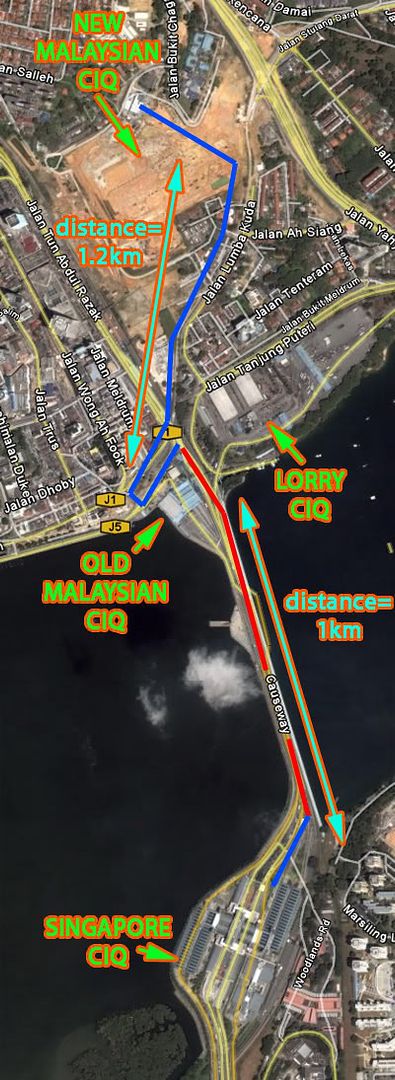 CIQ = Customs, Immigration & Quarantine
How do you measure progress? If Point A (old Malaysian CIQ) and Point B (Singapore CIQ) takes approximately 25minutes (distance of around 1km) to walk, you don't build something even further away and non-pedestrian friendly. The new Malaysian CIQ adds at least 1.2km more than the current distance in plan. In reality, it is more since the added distance is going uphill to the top of Bukit Chagar, where the new Malaysian CIQ building is situated.
How do you improve if the new building is creating more problems to the users? Let's not even talk about the crooked bridge yet since it does not make any improvements but creating more problems. For the sake of having water to go through both sides of the causeway and perhaps very small ships or boats or sails to go through, the sacrifices needed is extremely heavy. For the kind of money spent to build the crooked bridge for the sake of water connectivity between the current causeway as well as getting tiny recreational sea vehicle to go through, does it really make sense?
What is wrong with the current new Malaysian CIQ building?
1.
Messy vehicle link - the link to enter the CIQ building is so messed up and complicated because the traffic planning is very badly done. Many vehicles went the wrong way because of the confusing network of traffic junctions. This mess is further complicated with traffic policemen blocking the messy junction to catch vehicles, either to check the IC/ID or just to catch those who unfortunately got confused by the messy traffic junction. Some of the roads are closed, making it very confusing for drivers. As a result of this chaotic design, they need to have people full time standing at the entrance to guide traffic. It has been so from December 15th 2008 till now. You also see many policemen hanging around in the building. I don't know what they are doing in there chatting with each other when crime rate is sky high in Johor Bahru.
2.
Miserable pedestrian link - the building is the nightmare for all pedestrians. Old folks, disabled people and pregnant ladies can anticipate a hell of a time to enter this building. You plan to bring heavy luggage? Good luck to you! The only legitimate entrance to this building is through other buildings. Yes, there is no official entrance for pedestrians for this building. Hence, you find yourself going through the new railway station opposite City Square or another building linked to the new CIQ. This means before you even enter this building, you need to walk 15minutes-20 minutes (casual speed) to reach this building. When you finally enter the building, you need to go around in one loop from the side. Yes, they force you to walk double the building's length by going in from the sides and making a U turn to enter the main passport and Customs clearance area. That loop will at least take you another 15 minutes, not taking into account the passport queue. The path is not straight, you need to go through many rounds of escalators / stairs (if escalators broke down), therefore it is almost impossible for the disabled to enter. The old folks and the pregnant ladies will suffer. By the way, when it rains, it is as good as you will be fully wet since there is no pedestrian shelter whatsoever outside any of the buildings connecting to the new CIQ building.
3.
Miserable building materials - the building was in full operational since mid December 2008. We have escalators breaking down for months and still under repair. You have broken glass panels, you have leaking airconditioning making the floor below wet, you have the main entrance green ground plaster coming off here and there, you have information kiosk under repair for months, you have lifts and escalators being closed from use, you have broken lights. As for the information kiosk, who in the world will stop inside to use it? I saw one of these kiosks tucked at the corner of the building where nobody will be there. I wonder...
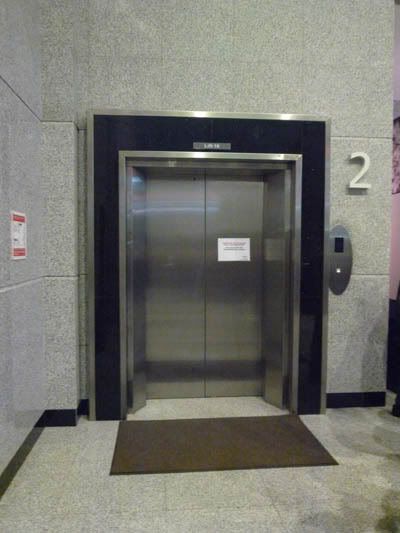
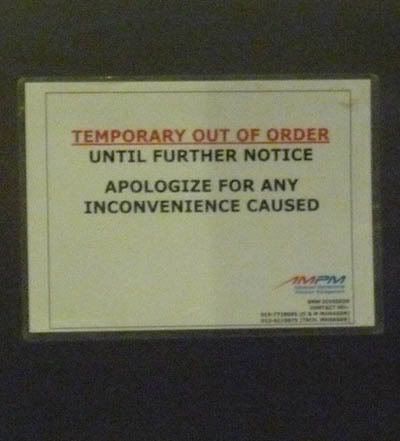
It is very common to see this in the building, be it on the lift, leaking airconditioning, broken glass panel left there for weeks, escalators and lightings. Therefore, those with luggages and having difficulty walking are the people to suffer the most.
4.
Freeflow airconditioning - Well, the high ceiling, huge building is like the Sepang International Airport where the amount of humans you have with the ratio of floor space is too far apart. You have huge space to be airconditioned while there are no doors or walls to shield the interiors. This means you have airconditioning free flow pumping down the staircases / escalators where people go to take buses and vans in the open air. We can waste energy like nobody's business.
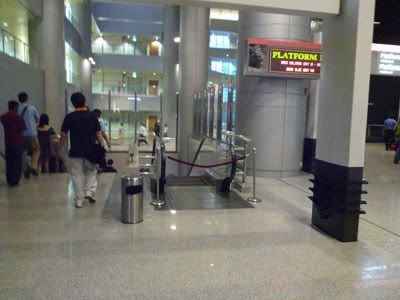
The photo shows three things. The extreme left is the double line queue which is having about 100 people each easily. The length can double easily. This photo was taken when I queued up to this point because I wanted to show how there is no barrier for the airconditioning to go down directly through the staircase and escalator for free to the outdoors. You can also see the escalator is not functioning. Good luck to the disabled, old folks, pregnant ladies and people with heavy luggage. You can see also the kind of huge space indoors with high volume space to burn energy. Free flow airconditioning and lighting.
5.
Slippery tiles - Yes, as I mentioned earlier above, there is no shelter for pedestrians when it rains. You better have umbrella ready or be ready to be soaked wet. In addition, the construction is super flat so when it rains, you have water contained here and there. The tiles used outdoors are slippery types which you can really fall down when it is wet. You see workers mopping floors everytime it rains. If you look at the Singapore CIQ, there is no such problem. They have logic and use rough tiles. It will not easily crack with the luggages going around.
6.
Tight curvy spaces - This is for cars entrance and exit. If you drive in or out of the new CIQ building to get passport clearance, the different kiosks handling different lanes are positioned in such a way that you can't even see whether there are any vehicles in other lanes. This means you could drive down to the last few lanes and only to find out that they are all full. The very tight corners have caused every single counter to have cut / knock marks by vehicles on it. Sometimes these lines can be as long as 2 metres. The bump used is extremely high which caused the vehicles to unnecessarily stop to go through slowly.
7.
No pedestrian pathway - Yes, this is the worst thing about this CIQ building. There is no pedestrian pathway to link to the Singapore side. This means you are forced to take transport, especially buses. Well, you will see super long queues as long as 2km in the CIQ building all the time during peak hours. People line up from the bus platform all the way till they reach the passport gate, which is about 2km away!
8.
Two lanes link - No matter how big the CIQ building is, there is only two lanes link to enter and exit Singapore. Since these lanes are not straight, this means you literally only have 1.5 or 1 lane to enter or exit Singapore. This is because huge vehicles like buses will eat up almost 1.5 lanes during corner turns. This curvy link is always holding up traffic jam. Imagine cars, motorcycles, vans and buses all share two lanes. We are talking about thousands of these vehicles. Since the road is going uphill, it is consuming a lot of petrol to all the vehicles. Just imagine yourself caught in the jam from the foot of the hill till the top of it. Just imagine the buses loaded with passengers trying to go uphill.
9.
Miserable interiors - They built a huge gigantic space in front of the passport clearance area when the crowd amount will never ever going to fill it up fully. At best, I would say they will mostly filled up 10% of the huge space. However, the space provided for bus waiting and queues are so tight that people literally need to squeeze through the space. That's how great the design is.
10.
Ugly sight - The columns left for the intended crooked bridge with steel bars all over it left to rot is an ugly sight indeed. The unfinished bridge is also left halfway there to welcome tourists into Johor Bahru. They also left the old immigration building to rot there without clearing it off. The decayed, dirty place is really an eye sore and dangerous for the traffic to go through it.
The Most Happiest People On EarthThere are only two types of people who are happiest with the new Malaysian CIQ. The bus companies since nobody can walk anymore and are forced to take their ever crowded buses with queues as long as 2km. The other one is the owner of the Shell petrol station at the exit of the Malaysian CIQ. They are basically striking lottery with good feng shui of money pouring in non-stop compared to the past.
What Is The Point of the Crooked Bridge?1. If you want the water on both sides of the causeway to connect, drill underground tunnels. Can't that solve the stagnant water?
2. How do you get your train to go through?
3. How do you get the water pipes to go through?
4. You want big ships to go through but is the straits deep enough?
5. Can they even go through under the Second Link?
6. What is the point of adding more buses when the problem to the connectivity is the amount of lanes between the Malaysia CIQ and Singapore CIQ? The two lanes are the bottleneck!
7. How can the crooked bridge improve business and Johor's economy as mentioned in the newspaper article below?
8. Are you sure the Johor Bahru people support it so wholeheartedly like what is reported below? All I know is every user including me is cursing everyday when we enter that CIQ building. As reported in the news, Johor UMNO Youth information chief Khalid Mohamad said
all the people of Johor, regardless of religious belief and race, wanted the government to review the decision made in 2006 to cancel the construction of the crooked bridge. All the people of Johor, regardless of religious belieft and race......right.
9. Why do you disallow people from walking to the other side? Do you think we enjoy walking further distance? If not for the terrible tight connectivity, everyone will prefer using vehicles.
10. I heard a giant ship carrying containers has a height of at least 50 metres from the sea water level. That is around 14 storeys high. What is the type of ship the bridge intend to let through?
11. How will the crooked bridge be a landmark to attract more tourists?
Sometimes I really don't understand what is reported in the local news. No logic.
What is a bridge? Why do we build a bridge?A BRIDGE IS USED AS A SHORTCUT TO CONNECT TWO SEPARATE LOCATIONS SEPARATED BY WATER BODY. THE KEY POINT IS A SHORTCUT, NOT TO MAKE IT A LONGER DISTANCE!-------------------------------------------------------------
No decision yet on crooked bridge, says Muhyiddin SINGAPORE, April 17 — The government has not made any decision whether to resume the construction of the crooked bridge over the Straits of Johor, said Deputy Prime Minister Tan Sri Muhyiddin Yassin.
After delivering the closing keynote address at the Second Asean and Asia Forum here today, Muhyiddin was asked about the growing calls, especially from Johor’s political and business community, for the government to review its 2006 decision to cancel the crooked bridge project.
The say the construction of the RM600 million crooked bridge to replace the Johor Causeway which was built in 1924, could spur economic growth and provide various economic opportunities to the local population.(COULD, HOW? HOW IS HAVING A CROOKED BRIDGE PROVIDE MORE ECONOMIC OPPORTUNITIES, PLEASE ENLIGHTEN ME!)
The forum titled “Risks and Opportunities” was organised by the Singapore Institute of International Affairs (SIIA).
Asked on his priority since taking over as deputy prime minister, Muhyiddin said the most important thing on his mind was managing the economy and steering it out of recession.
He said the nation’s economic well-being needed to be managed hands-on, especially with the RM60 billion economic stimulus package as announced by Prime Minister Datuk Seri Najib Razak recently.
The Umno deputy president said the government’s priority in ensuring Malaysia’s well-being went beyond politics and the impending Penanti state seat by-election.
“Yes, we (the new administration) are looking beyond politics,” said Muhyiddin.
On Umno’s efforts to regain the confidence of the Malays and Malaysian public, he said the new party administration was working hard towards this end.
“We are working very hard on the party’s transformation, but with the new administration in place, there will be changes which can have a positive impact.”
Muhyiddin said Umno and Barisan Nasional needed at least two years to work at winning back the confidence and trust of the Malaysian voters.
He left for Kuala Lumpur after attending the forum. – Bernama
Singapore-JB bus links to doubleSINGAPORE, April 16 — The number of bus services linking Singapore and Johor Baru is being doubled from eight to 16.
This is to cater to the expected demand from people heading to the Iskandar region in Johor.
Iskandar is a development corridor in the southern part of the state, about three times the size of Singapore.
The two countries agreed on the move to “enhance transport links” after the fourth meeting of the Malaysia-Singapore Joint Ministerial Committee earlier this month.
No deadline has been set for the move yet.
Operators of these cross-border services said it was a good move to have more services and expressed interest in applying to run them.
The services that now ply routes between Singapore and Johor Baru are run by local companies SBS Transit, SMRT and Singapore-Johore Express Bus Service, as well as Malaysian company Handal Indah.
There is no limit to the number of trips that they can make per day.
These buses are similar to regular service buses that run on Singapore roads and are not the large express tour buses that go to other parts of Malaysia such as Kuala Lumpur, Ipoh or Penang.
Said operations officer Wang Liang Jiong of Singapore-Johore Express: “If the opportunity arises, it is definitely one we will consider.
“In the current economic conditions, more people would rather take the bus to Johor than opt for taxis or other means.”
The company, which started in 1947, runs a direct service from Ban San Street terminal in the Bugis area to Larkin terminal in Johor.
A visit by The Straits Times on a weekday afternoon found at least 15 people lining up to buy tickets for the service, which costs S$2.40 (RM5.80) from Singapore to Johor Baru and RM$2.50 on the return leg.
There is no printed schedule for this service, which makes another trip whenever buses return from Johor.
“Traffic jams can really be unpredictable but our customers don't usually have to wait that long for the next bus to arrive,” said Wang.
Also running from Ban San Street to Larkin Terminal is SBS Transit's service 170.
Its other service, 160, runs from the Jurong East Interchange to the Kotaraya II terminal in Johor.
These buses stop at a number of bus stops along the way before crossing over to Johor. The fare costs between 69 cents and S$1.65.
SBS Transit's spokesman said that it would monitor demand for such services before deciding whether to apply for new services.
Like SBS Transit's buses, SMRT's service 950 stops at a number of bus stops in Woodlands before heading to the Kotaraya II terminal.
The fare is between 69 cents and S$1.11 each way, and the bus frequency is less than 15 minutes from Singapore.
Said SMRT's spokesman: “We welcome the move by both governments to enhance travel between Singapore and Johor, and look forward to the opportunity to serve more commuters between the two regions.”
The move follows news that links between Singapore and Malaysia are also taking off aviation-wise.
On Tuesday, carriers on both sides of the Causeway were given the green light to operate between Singapore and six popular destinations in Malaysia, including Ipoh, Kuantan and Malacca. — The Straits Times
(LIKE I SAID, BUS COMPANIES ARE THE BIGGEST WINNERS FROM THIS NEW CIQ BECAUSE PEOPLE ARE FORCED TO TAKE THEM! NO MATTER HOW LONG THE QUEUE IS, YOU HAVE NO OTHER CHOICES!)Malay chamber eyes RM10b Gemas-JB double-track railway projectKUALA LUMPUR, April 14 — The Malay Chamber of Commerce Malaysia is keen to be the main contractor for the Gemas-Johor Baharu double-track railway line project, president Syed Ali Alattas said today.
He hoped the government would soon call for tender for the RM10 billion project.
“We are waiting for an opportunity from the government to develop the project,” he told a media briefing.
Syed Ali said the chamber intends to develop the project under the Private Finance Initiative.
For the purpose, Yayasan DPMM subsidiary, Master Vendor Corporation Sdn Bhd, signed a memorandum of understanding with China Railway Construction Corporation Ltd four months ago.
“We’ve negotiated with China Railway and they agreed to help us carry out the project,” he said.
Under the MoU, China Railway will, among others, provide the expertise and construction materials and assist Master Vendor to secure financing from Eximbank China.
China Railway is one of the biggest mega construction companies and most influential in China.
“We believe some 1,000 contractors, especially small-time contractors, will benefit from the project,” he said.
Syed Ali also urged the government to re-start the “crooked bridge” project linking Johor Baharu to Singapore to
stimulate economic growth in Johor.
(COULD, HOW? HOW BEING CROOKED CAN PROVIDE MORE ECONOMIC OPPORTUNITIES, PLEASE ENLIGHTEN ME!)He said the chamber received numerous complaints from traders and entrepreneurs in the state that the bridge cancellation in 2006 had impeded their business growth, hence rendering Johor Baharu City “dead”.
(EVEN IF IT IS BUILT, THE TRAFFIC IS STILL GOING UP TO THE HILL, AWAY FROM THE CITY CENTRE!)“Also, the existing road linking Johor Baharu and Singapore is winding and meandering, inconveniencing road users,” he said.
(WILL THE CROOKED BRIDGE HAS LESS CORNERS AND MORE LANES? IF NOT, IT WILL BE THE SAME!)Syed Ali also gave the chamber’s commitment if the government intends to revive the nearly-half-completed bridge project. — Bernama
The return of the ‘crooked bridge’?JOHOR BARU, April 14 — Over the past few days, the mainstream media has been making a case to revive the crooked bridge across the Johor Strait, a project cancelled by Tun Abdullah Ahmad Badawi in his early days as prime minister that irked his predecessor Tun Dr Mahathir Mohamad.
Abdullah had cancelled the project in 2006, citing legalities that have to be pursued with Singapore and a high deficit in government spending.
Despite the cancellation, the government had to compensate several contractors linked to the project.
Today, state news agency Bernama reported that reviving the project under the new leadership of Datuk Seri Najib Tun Razak
would meet the aspiration of the Johor people, quoting Umno Youth information chief Khalid Mohamad as saying
the people wanted the project reconsidered. (WHO ARE THESE PEOPLE? ASPIRATION MY ASS!)“The people of Johor are placing high hopes on the prime minister to review the decision to cancel the crooked bridge project across the Johor Straits. (EVERY USER OF THE CIQ ARE CURSING! WHICH PEOPLE DID YOU ASK?)“The effects from the construction of the crooked bridge will be most positive to the Johor economy. We urge the government to reconsider (the cancellation) as soon as possible,” said Khalid who is also the Johor Baharu Umno Youth chief, at a media conference, here today.
(HOW POSITIVE? IT WILL BE THE SAME WHETHER STRAIGHT OR CROOKED!)He said although the country was facing the global economic slowdown, the construction of the crooked bridge would stimulate the local economy and bring it out of the recession. (CONSTRUCTION WILL ONLY BENEFIT YOUR OWN PEOPLE!)“
It (the construction of the bridge) is a long-term investment and no one can deny the positive effects arising from the construction of the bridge to the Johor economy and in creating various economic opportunities,” he said.
(WHAT OPPORTUNITIES?)On the possibility of Singapore protesting the revival of the project, he said both countries were capable of avoiding the issue from being made a collateral in resolving outstanding problems.
Yesterday, the public including associations and the Johor Chinese and Indian Chambers of Commerce expressed confidence that the cancellation of the crooked bridge project would be reviewed by Najib’s administration.
The Star newspaper last week also reported that Johor Baru residents and businessmen welcomed the project as the new Custom facilities has diverted traffic from the city.
Pak Lah: Budget deficit killed the crooked bridgePUTRAJAYA, April 1 – Outgoing Prime Minister Abdullah Badawi cancelled the so-called crooked bridge project between Johor and Singapore in 2006 because of the huge federal budget deficit then.
He told media editors yesterday that his Cabinet ministers were puzzled by former premier Mahathir Mohamad’s insistence on going ahead with the project.
Datuk Seri Abdullah was asked whether his ties with Tun Dr Mahathir would have been better if the Malaysian government had not scrapped the plans to build the bridge to replace the Johor Causeway.
Abdullah said he had no pre-conceived idea on the project before the decision was made to stop it in April 2006.
“We had to consider it...I didn’t have a pre-conceived idea about it...that I was going to stop it. This was one issue that has been brought up to the Cabinet time and again,” he said.
He said the federal budget had a 5.3 per cent deficit then and if the government had gone ahead with the project, it would not have extra funds to launch an economic stimulus package afterwards.
During his term, Premier Mahathir insisted that he would build an elevated bridge on Malaysia’s side of the border after Singapore said it saw no reason to demolish the Causeway.
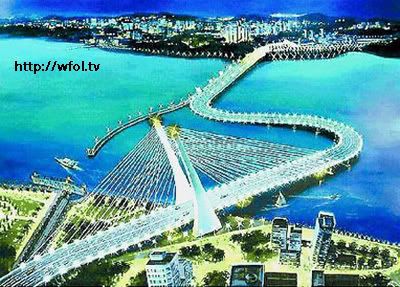
Singapore had said it was prepared to agree to the bridge plan if a balance of benefits could be struck for both sides. The S-shaped half-bridge was widely called the “crooked bridge”.
The bridge issue became a major sticking point between Dr Mahathir, who stepped down in October 2003, and his hand-picked successor when the two fell out soon after the project was dropped.
Both leaders had made a public show of rapprochement at Umno’s annual meeting last Saturday. But on Monday, Dr Mahathir told the BBC that “everything went wrong when Abdullah took over”. Yesterday’s comments by Abdullah showed the tension between them remains.
Abdullah said he is convinced that his successor Najib Razak will continue to implement programmes initiated during his administration. He said these included the various development corridors and the Islam Hadhari, or Civilisational Islam, concept that he introduced. – The Straits Times
(FIRST IT WAS THE PEOPLE OF JOHOR BAHRU WHO DON'T WANT IT. THEN, IT WAS THE SAND SELLING TO SINGAPORE AND AIRSPACE GIVEN TO SINGAPORE. NOW THIS? SUDDENLY THE PEOPLE OF JOHOR BAHRU WANT IT AGAIN!)Construction of crooked bridge meets people's aspiration(Bernama) - The revival of the crooked bridge project across the Johor Straits under the new leadership of Datuk Seri Najib Tun Razak
meets the aspiration of the Johor people.Johor UMNO Youth information chief Khalid Mohamad said
all the people of Johor, regardless of religious belief and race, wanted the government to review the decision made in 2006 to cancel the construction of the crooked bridge.
"The people of Johor are placing high hopes on the Prime Minister to review the decision to cancel the crooked bridge project across the Johor Straits.
"
The effects from the construction of the crooked bridge will be most positive to the Johor economy. We urge the government to reconsider (the cancellation) as soon as possible," said Khalid who is also the Johor Bahru UMNO Youth chief, at a media conference, here today (14 April).
He said although the country was facing the global economic slowdown, the construction of the crooked bridge would stimulate the local economy and bring it out of the recession.
"It (the construction of the bridge) is a long-term investment and no one can deny the positive effects arising from the construction of the bridge to the Johor economy and in creating various economic opportunities," he said.
On the possibility of Singapore protesting the revival of the project, he said both countries were capable of avoiding the issue from being made a collateral in resolving outstanding problems.
Yesterday, the public including associations and the Johor Chinese and Indian Chambers of Commerce expressed confidence that the cancellation of the crooked bridge project would be reviewed by Najib's administration.
Crooked bridge may help biz(The Straits Times) - SEVERAL Johor business leaders and a state Umno chief have said the so-called
crooked bridge project at the Causeway should be revived to help stimulate the economy, media reports said.
(STIMULATE YOUR OWN CONTRACTORS' ECONOMY!)Johor Baru residents and businessmen have welcomed the project, proposed by former prime minister Mahathir Mohamad during his term, as the new Customs facilities have diverted traffic from the city.
The opening of the new Sultan Iskandar Customs, Immigration and Quarantine Complex at Bukit Chagar last December saw the old Causeway checkpoint about 500m away closed for good.
Johor Baru Chinese Chamber of Commerce and Industry president Soh Poh Sheng said on Monday that he was confident that
businesses in the city would boom if the project was revived. '
The bridge will be a landmark for Johor Baru to attract more tourists to the city,' The Star newspaper quoted him as saying.
(THIS IS THE MOST FUNNIEST ONE! TOURISTS ARE ATTRACTED TO CROOKED STRUCTURES SINCE YOU CAN ONLY FIND IT IN MALAYSIA!)State news agency Bernama on Tuesday reported Umno Youth information chief Khalid Mohamad as saying the people of Johor wanted the project reconsidered. On the possibility of Singapore protesting against the revival of the project, he said both countries were capable of preventing 'the issue from being made a collateral in resolving outstanding problems'.
He was talking about a previous plan to build an S-shaped half-bridge across the Strait of Johor to replace Malaysia's side of the Causeway. The plan was scrapped in 2006 by Tun Abdullah Badawi in his early days as prime minister.
Singapore had said it saw no reason to demolish the Causeway, and said it was prepared to agree to the bridge proposal if a balance of benefits could be struck for both sides.
Prime Minister Najib Razak has not spoken publicly about his position on the crooked bridge since taking office.
Speaking days after the decision to abort the project three years ago, Datuk Seri Najib, who was then the deputy prime minister, had said that Malaysia hoped Singapore would one day realise a bridge to replace the 81-year-old Johor Causeway was good for both countries.
Malaysia: The ‘crooked bridge’ returns Written by Ali Cordoba
Tuesday, 14 April 2009
Ali Cordoba - Riau, Indonesia (14th April 2009)
Reports in a local Malaysian newspaper suggests that the famous abandoned ‘crooked bridge’ between Singapore and Malaysia at the Johor Causeway will be back on the table. Instability will be at play and it could lead to another battle of the ‘titans’ within the United Malays National Organization (Umno).
The crooked bridge issue is one that is dear to Tun Dr Mahathir Mohamad, the returning leader of the United Malays National Organization (Umno) who is now more powerful than ever behind the scene. Will do or will not do the ‘crooked bridge’? It will all depend on how powerful Tun M as he is commonly called nowadays is within the Prime Minister’s circle.
Two factors will affect the next decision that the Malaysian government will make on the ‘crooked bridge’: Money and bilateral relations.
The recent meeting between Prime Minister Najib Tun Razak and the Singapore Premier Lee Hsien Loong was warm and cordial, setting the pace for better relations between the two neighbouring states. Prime Minister Najib Razak has been a regular visitor to Singapore as Minister of Defence and is said to have very good relationship with the ruling class in Singapore, which is a good sign as this may quell any attempts of unwarranted trouble between Malaysian and Singapore.
Malaysia-Singapore ties have warmed since Malaysia's outspoken former Prime Minister Mahathir Mohamad handed power to Abdullah Ahmad Badawi late in 2003. It is getting warmer now; say observers who added that with Najib in power, the crooked bridge may still be a dead venture despite the strong return of Tun M within the corridors of power in Malaysia.
Former premier Tun Mahathir unveiled the plan for a bridge to replace half the 500-m causeway between the neighbours in 2003, after Singapore rejected a plan to jointly build a bridge to replace the entire causeway.
Malaysia says its bridge, called the "crooked" bridge because of its convoluted design, would boost traffic flow and eases jams on its side of the 81-year-old causeway, allow ships to pass beneath and improve water quality by unblocking the strait.
Lately, Tun M said the bridge may be brought back to the limelight due to the new customs lane built in Johor Bahru (Sultan Iskandar Customs, Immigration and Quarantine (CIQ) Complex) that has created much controversy and congestion in traffic between Malaysia and Singapore. He said that the bridge will help alleviate the congestion and will also benefit the Iskandar project, which was heavily criticized by Tun M when former Prime Minister Abdullah Ahmad Badawi announced the creation of these projects. Tun M was virulent in his criticism of Badawi upon the rejection of the crooked bridge by the Badawi regime.
As talks on the bridge have dragged on, Malaysia has gone ahead with a key part of its M$1.1 billion ($292 million) project, building a customs, immigration and quarantine centre at Johor Baru, the main gateway to Malaysia from Singapore, wrote the Straits Times in 2006.
Singapore is in disagreement over the bridge due to the following official reasons:
1. It will affect Singapore’s economy
2. It will also disrupt the long standing water supply deal agreement between Malaysia and Singapore
3. It will be an environment disaster altogether
On the other hand, Tun Mahathir insisted the reasons given by Singapore were irrelevant and that the bridge should have been built a long time ago. He rejects the fact that due to the ‘water’ deal with Singapore, the nod of Singapore is needed to build even the Malaysian side of the bridge since this will affect the Public Utilities Board (PUB) of Singapore.
This included Malaysia’s obligations under the Johor-Singapore water agreements of 1961 and 1962, the Wayleave Agreements and the Separation Agreement 1965.
The main obstacle to the crooked bridge was that it would involve the demolition of the Malaysian side of the Johor Causeway. The demolition would directly affect the water pipeline located inside the Johor Causeway and water pipelines straddling the Johor Causeway in which the ownership is vested with the Public Utilities Board of Singapore.
Nevertheless, the crooked bridge issue is back on the table and will be much debated soon with Tun M’s insistence that it must be built. Prime Minister Najib Razak, in an interview in the Edge, a Malaysian newspaper, showed he was not that keen on the crooked bridge.
Najib in an interview with The Edge noted that while there may be some individual views about the project there are legal ramifications to consider as well as the financial constraints facing the government. This could lead to the next battle of the titans within the Umno and it could also lead to the possible, early removal of Najib Razak from power if Tun M is dissatisfied in the event he is totally against the construction of the crooked bridge.
WFOL was told in 2006 that the crooked bridge was abandoned in order to prevent any scuffle between Malaysia and Singapore. Building it without the consent of Singapore would surely mean the disruption of the relationship between the two neighbours.
That dream bridge of mine By LIM MUN FAH/Translated by DOMINIC LOH/Sin Chew Daily
During the Mahathir era, it spanned across the sky, making many think of it day in and day out.
During the Abdullah era, it was killed, making many feel at loss.
During the Najib era, it is resuscitated, making many gleam with excitement.
That, is the bridge in my hometown. The bridge of my dream.
This bridge, a crooked one, will span across the narrow strait, proudly overlooking Johor and Singapore on both sides.
In the artist's rendering, it is as beautiful as the dreamy fairytale world.
It even has an idyllic name, "the Scenic Bridge."
In the end the bridge is never built. And it remains very much the bridge of my dream.
By halting the construction of the bridge, we have compensated RM1.277 billion!
Former prime minister Tun Abdullah said the government was short of cash then, and the budget deficit ran as high as 5.3%.
He said the Cabinet had been discussing about this bridge over and again, and no one could understand why Mahathir had insisted to go ahead with the plan.
Frankly, I also didn't know what was in Mahathir's mind.
I only knew he was very unhappy that Abdullah had shelved the crooked bridge plan.
Again, I had no idea at all why he was so furious about it.
I only knew Mahathir has not been in good terms with Abdullah since then.
Mahathir later said, "I used to swear that I would not poke my finger into the new administration. I did try for some time, but after that crooked bridge incident, we have surrendered our sovereignty to our neighbour. And that is utterly disgraceful!"
He even said, "I could understand why if it were America. But now we are even scared of a tiny country like Singapore.
"I don't think he makes a respectable leader."
Now I know that this bridge entails more than just the intricate politico-business interests, but also our sovereignty and self-esteem!
Abdullah has left, and here comes Najib. And Mahathir.
Mahathir's brainchild is beginning to see some prospects of revival, thanks also to the strong endorsement from Johor UMNO Youth.
In an identical tone to that of Mahathir, Johor UMNO Youth information chief Khalid Mohamad said if Singapore did not agree to the plan, we could always build a crooked bridge entirely on Malaysian territory.
Khalid Mohamad claimed that the crooked bridge would bring more positive impact on Johor's economy.
But he failed to tell me whether this "half bridge," which can only be built up to the midline of the Johor Strait, would promote the state's economy, or send the economy back in time by half a century.
I am wondering whether the bridge of my dream is to be built with our economy in mind, or our politicians.
Labels: CIQ, crooked bridge


